
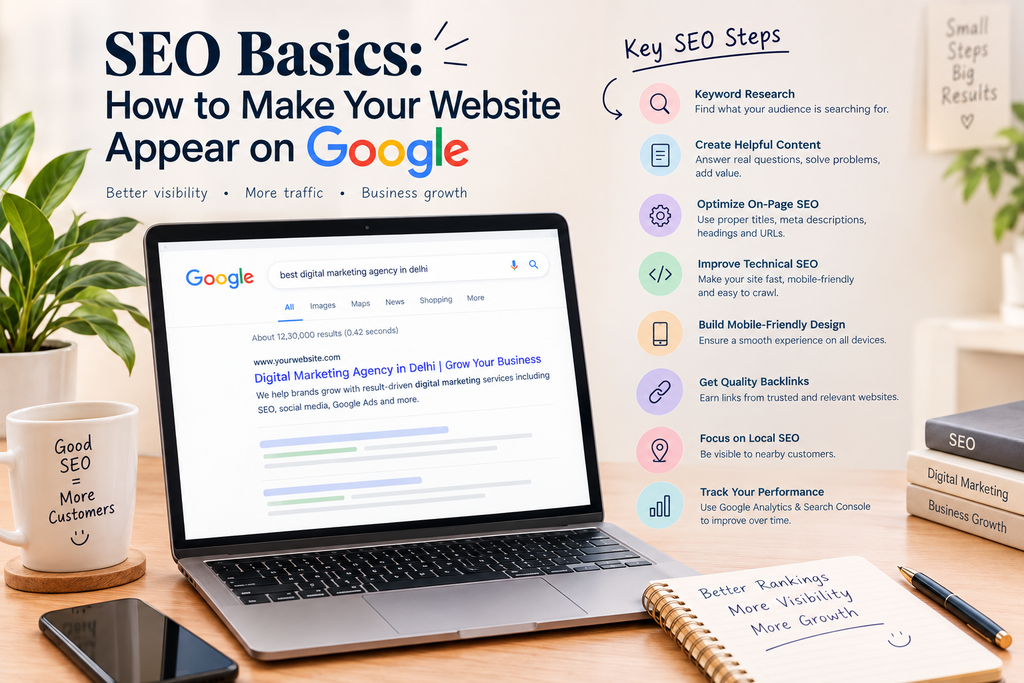
Having a website is important for any business, but simply creating a website does not guarantee that people will find it. When potential customers search for products, services, or information on Google, you want your website to appear in relevant search results. This is where SEO (Search Engine Optimization) comes in.
SEO helps improve your website’s visibility in search engines and can bring more visitors without requiring you to pay for every click. For beginners, SEO may sound complicated, but its basic principles are easy to understand.
What Is SEO?
SEO stands for Search Engine Optimization. It is the process of improving your website so that search engines can better understand its content and show it to people searching for relevant information.
For example, if you own a digital marketing agency and someone searches for “digital marketing agency in Delhi,” you want your website to have a chance of appearing in those search results.
The goal of SEO is not simply to get more website visitors. It is to attract relevant visitors who are actually interested in what your business offers.
Why Is SEO Important?
SEO can benefit businesses in several ways:
- Increases visibility: Helps people discover your website through search.
- Generates organic traffic: Brings visitors without paying for every click.
- Builds credibility: A useful, trustworthy website can strengthen your brand.
- Supports long-term growth: SEO can continue generating traffic when maintained properly.
- Reaches customers with intent: Searchers are often actively looking for information, products, or services.
For small businesses, good SEO can provide an opportunity to compete for relevant searches even against larger companies.
1. Start With Keyword Research
Keywords are the words and phrases people type into search engines.
Before creating content, find out what your potential customers are searching for.
For example, a bakery might target phrases such as:
- Best bakery near me
- Birthday cakes in Delhi
- Custom cakes in Delhi
- Eggless birthday cakes
Don’t choose keywords simply because they have high search volume. Focus on keywords that are relevant to your business and match the searcher’s intent.
Tools such as Google Keyword Planner and other SEO platforms can help you discover keyword ideas.
2. Create Helpful, High-Quality Content
Content is one of the most important parts of SEO.
Create content that genuinely helps your audience. This could include:
- Blog posts
- Guides
- Tutorials
- FAQs
- Product pages
- Service pages
- Case studies
Instead of writing articles only to include keywords, answer the questions your audience actually has.
For example, a digital marketing agency could create an article explaining “How Meta Ads Work for Small Businesses.”
Useful content can attract visitors, build trust, and increase the chances of people returning to your website.
3. Optimize Your Website’s On-Page SEO
On-page SEO refers to improvements made directly to your website pages.
Important elements include:
Page Titles
Create clear titles that explain what the page is about and naturally include relevant keywords.
Meta Descriptions
Write a short and attractive description that encourages users to click your result.
Headings
Use headings such as H1, H2, and H3 to organize your content.
URLs
Keep URLs simple, descriptive, and easy to understand.
Images
Use descriptive file names and appropriate alternative text (alt text) for images.
These elements help both users and search engines understand your pages.
4. Improve Technical SEO
Technical SEO focuses on how easily search engines can access, understand, and crawl your website.
Make sure your website:
- Loads quickly
- Works well on mobile devices
- Has a clear site structure
- Uses HTTPS
- Doesn’t contain unnecessary broken links
- Has important pages that can be crawled and indexed
A technically healthy website provides a better experience for visitors and makes it easier for search engines to understand your content.
5. Make Your Website Mobile-Friendly
A large number of people browse the internet using smartphones. Therefore, your website should work properly on smaller screens.
Check whether:
- Text is easy to read
- Buttons are easy to tap
- Images fit the screen
- Pages load quickly
- Navigation is simple
A poor mobile experience can frustrate visitors and make them leave your website.
6. Build Quality Backlinks
A backlink is a link from another website to your website.
Links from relevant and reputable websites can help establish your site’s authority. However, the goal should be quality rather than quantity.
You can earn relevant backlinks by:
- Publishing useful original content
- Contributing expert insights
- Building partnerships
- Creating resources others want to reference
- Promoting valuable guides or research
Avoid trying to manipulate search rankings through spammy or artificial links.
7. Focus on Local SEO
If you run a local business, local SEO can be especially useful.
For example, a salon in Delhi wants to appear when nearby customers search for services such as “beauty salon near me.”
Make sure your business information is accurate and consistent across relevant online platforms. Create useful location-specific website content and encourage genuine customer reviews.
8. Track Your SEO Performance
SEO requires patience. You should regularly check whether your efforts are producing results.
Useful metrics include:
- Organic traffic
- Search impressions
- Clicks
- Click-through rate (CTR)
- Keyword rankings
- Conversions
- Leads or sales
Tools such as Google Search Console and Google Analytics can help you understand how people discover and interact with your website.
Common SEO Mistakes to Avoid
Beginners often make a few common mistakes:
- Stuffing keywords unnaturally into content
- Copying content from other websites
- Ignoring mobile users
- Creating content without understanding search intent
- Buying low-quality backlinks
- Expecting results immediately
- Forgetting to update outdated information
SEO is a long-term process. Consistency and quality are more important than shortcuts.
How Long Does SEO Take?
SEO usually doesn’t produce instant results. The time required can vary depending on factors such as your website’s history, competition, content quality, technical condition, and industry.
Instead of looking for quick results, focus on steadily improving your website and providing useful information to your audience.
Conclusion
SEO is one of the most effective ways to improve your website’s visibility on Google and attract relevant organic traffic.
Start with keyword research, helpful content, on-page optimization, technical SEO, mobile-friendly design, quality backlinks, and local SEO where appropriate. Then track your performance and continue improving.
The most important thing to remember is simple:
Don’t create a website only for search engines. Create a useful website that genuinely helps people.
When you combine a good user experience with strong SEO fundamentals, you give your website a better opportunity to be discovered and support your business growth.